
What are Japanese incense sticks?
The first time most people light a Japanese incense stick, they're surprised by what doesn't happen: no thick smoke, no overpowering smell, no need to open a window. Just a thin, quiet thread of scent rising from a barely visible ember. That difference isn't accidental — it's the result of over 1,350 years of craft.
The Japanese art of incense — known as "Koh" — has its roots in Buddhist practice. What began as ritual offerings in temples evolved over centuries into something far more refined: a fragrance culture built around subtlety, precision and intentionality. Japanese craftsmen developed their own approach to incense with a specific goal in mind — not heavy, room-filling smoke, but a quiet, controlled scent experience. Fine. Deliberate. Present.
Today, Japan is home to some of the world's finest incense, made with the same materials and methods that have been passed down through generations. Our incense sticks come directly from this tradition.
The key difference: no bamboo core
The most important thing that sets Japanese incense apart from most others is invisible — literally.
Many incense sticks, particularly those from India and China, contain a thin strip of bamboo running through the centre as a structural support. That core holds the stick upright, but it also burns along with everything else. What you smell is never purely the intended fragrance — it's always a mixture of the scent and the smell of burning bamboo. A woody, slightly bitter undertone that clouds and distorts everything around it.
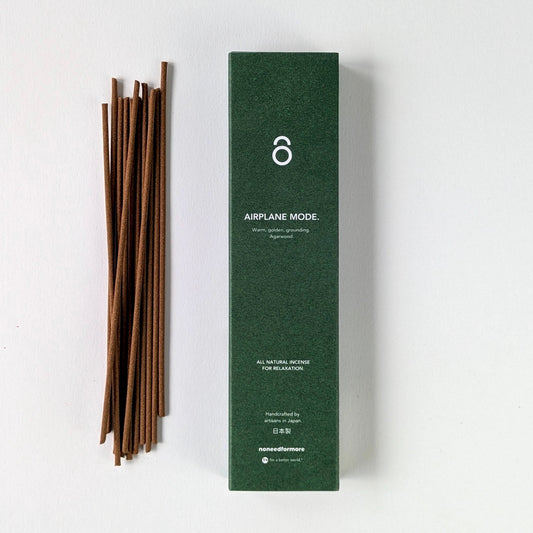
Japanese incense sticks without a bamboo core consist entirely of compressed fragrance material. When you light one, only the aromatic ingredients burn. No bamboo, no off-notes, no distortion. The scent stays exactly as it was designed to be: clean, precise and pure.
The difference is also visible: far less smoke, a more even burn — and a scent experience that simply isn't achievable with cheaper alternatives.

What's inside? The ingredients
Our Japanese incense sticks are made from three base components plus the fragrance material specific to each scent — nothing more, nothing less.
Machilus Tree Powder (Tabu-no-ki bark)
This is the traditional Japanese binding agent that has been used in incense-making for centuries. The bark of the Machilus Thunbergii tree is finely ground and acts as a neutral, odourless base that holds the fragrance materials together. It burns completely clean and leaves no scent of its own.
Activated Charcoal
This is the reason our incense produces so little smoke. Activated charcoal absorbs excess particles during combustion, naturally filtering the burn. The result is a barely visible, delicate thread of smoke rather than thick white clouds — and a cleaner, purer fragrance experience.
Sandalwood
As the third base component, sandalwood gives depth and warmth to the stick. It also acts as a natural fixative — helping to stabilise the fragrance during the burn and ensuring the scent remains consistent from the moment you light it to the moment it finishes.
On top of these three, each stick contains its specific fragrance ingredient — agarwood, hinoki cypress, plum blossom — depending on the scent. No synthetic additives. No preservatives. No dyes. Only what belongs there.
How Japanese incense sticks are made
The production of Japanese incense is painstaking work — and it's still done largely by hand. A method that has been practised for over 170 years, refined in specific regions of Japan that became the world's leading production sites for fine incense.
The process begins with blending: Machilus powder, activated charcoal, sandalwood and the fragrance materials are combined with water and worked into a smooth, kneadable paste. The challenge is greater than it sounds — raw ingredients smell different from burned ones, and many materials change their character entirely during combustion. Experienced makers need to know how a blend will smell once it's lit, not how it smells in the bowl.
The paste is then pressed through small openings — similar to how pasta is made — and shaped into even sticks. What results are sticks with no hollow core, no structural support, made entirely of fragrance mass.
Then comes the drying: sticks are laid out in shallow wooden frames and dried at carefully controlled temperature and humidity for several days. In the early years of Japanese incense production, craftsmen relied on the strong seasonal winds of their coastal regions for this step — a natural advantage that helped establish Japan's dominance in fine incense-making.
The result of this careful process: sticks that burn evenly and consistently, hold their scent from beginning to end and finish cleanly.

The benefits: less smoke, no headaches, pet-friendlier
People who switch from standard incense sticks to Japanese ones tend to notice a difference immediately.
Less smoke
Thanks to the activated charcoal in the blend, our incense sticks burn exceptionally cleanly. The smoke is barely visible — a thin, delicate trail that dissipates quickly. No smoky room, no stinging eyes, no reaching for the window after ten minutes.
No headaches
Many people find that cheap incense sticks give them headaches or nausea — a common reaction to synthetic fragrance materials or low-quality fillers being burned. Because our sticks contain only natural ingredients and no bamboo core contributing its own combustion, that effect simply doesn't occur. Incense without the aftermath.
Pet-friendlier
Dogs and cats are far more sensitive to strong smoke and synthetic fragrances than humans — their respiratory systems simply aren't built for it. The low smoke and natural ingredients of our incense sticks make them considerably more compatible with pets than most incense products. One important note: even with very little smoke, always ensure good ventilation when burning incense and give your pets the option to leave the room.
Gentle, precise scent
Without a bamboo core, without fillers, you smell exactly what's in the stick — and nothing else. That's the real luxury of Japanese incense: not volume, but precision.
When to use them
Japanese incense sticks suit moments that deserve calm.
Meditation and yoga
Light a stick before you begin, breathe in for a moment, set it down — and transition into your practice. The scent marks a shift. Agarwood for deep, grounding sessions. Hinoki for clarity and focus.
An evening ritual
Lighting a stick as a deliberate signal to yourself: the day is done. Twenty-five to thirty minutes — enough for a book, a bath, a quiet conversation.
Working and reading
Low smoke, no irritation, no overpowering presence. Japanese incense makes an ideal background scent — present without demanding attention.
Everyday life at home
Even without a formal practice, a burning incense stick changes the atmosphere of a room in a way that's hard to put into words. Try it once and you'll understand what we mean.

How to light Japanese incense sticks
- Hold in a flame. Hold the end of the stick in a candle flame — it gives more even heat than a lighter. 5 to 10 seconds, until the tip glows.
- Wave out the flame. Gently wave out the flame. The stick should now glow evenly and release a fine, barely visible thread of smoke.
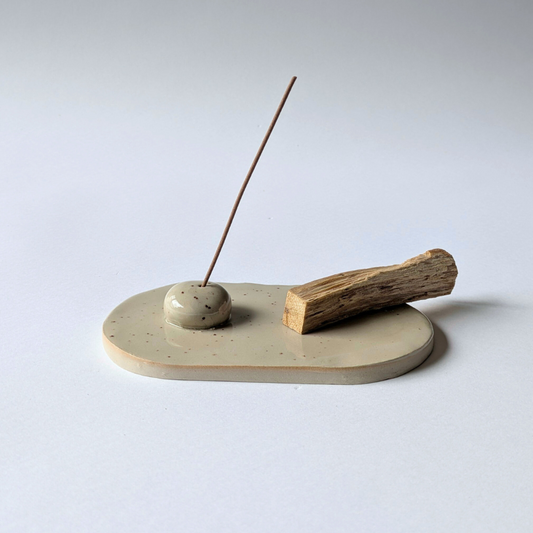
- Place in a holder. Japanese incense sticks without a bamboo core are more compact and structurally stable than bamboo-based sticks — our handmade ceramic holders fit perfectly.
- Let it burn. A stick needs no supervision. The ash stays compact and doesn't scatter.
- Store carefully. Keep unused sticks in a dry, dark place — the scent stays stable for months.
What to look for when buying
No bamboo core
This is the most important question when buying Japanese incense sticks. Traditional Japanese sticks don't need a structural support — the compressed fragrance mass holds itself together. If a product description doesn't mention this, it's worth asking.
Transparent ingredients
Serious makers tell you what's inside. Activated charcoal, Machilus tree powder, sandalwood and the fragrance material — that's all it takes, and all it should contain.
Low smoke as a quality indicator
Heavy white smoke from cheap sticks signals fillers or poor materials. Good Japanese incense barely smokes — that's not a limitation, it's a commitment to quality.
Origin and craft
Japan has an incense tradition spanning over 1,350 years. Products from this tradition carry that in every detail — from the materials to the finish.
Our Japanese incense sticks meet all of these criteria. No bamboo core. Natural ingredients only. Made in Japan using traditional methods.
→ Explore all Japanese incense sticks

FAQ
What is the difference between Japanese and other incense sticks?
Japanese incense sticks are made without a bamboo core — they consist entirely of compressed fragrance material. This means less smoke, a purer scent and a cleaner burn. Most cheaper incense from India or China contains a bamboo core that burns alongside the fragrance and alters the overall smell.
Why do your incense sticks contain activated charcoal?
Activated charcoal absorbs excess particles during combustion — the result is barely visible smoke and an exceptionally clean fragrance experience. It's also why our incense sticks are more tolerable for many people who find standard incense too harsh.
Are Japanese incense sticks safe for pets?
The low smoke and natural ingredients make Japanese incense sticks considerably more compatible with pets than most incense products. That said, animals can still be sensitive to scents. Always ensure good ventilation and give your pet the option to leave the room.
Can Japanese incense sticks cause headaches?
Cheap incense sticks with synthetic fragrance materials or poor-quality fillers often do. Our sticks contain only natural ingredients and no bamboo core — most people who experienced headaches from other incense find these completely tolerable.
How long does a Japanese incense stick burn?
Approximately 25–30 minutes. The compact composition without a bamboo core ensures an even burn from start to finish.
Which holder do I need?
Our handmade ceramic holders work perfectly. They have a sufficiently deep groove to hold the stick securely and catch the ash reliably.